Preclinical Dose Data

BPC-157 Dosage: Protocols Used in Preclinical Research

BPC-157 dosage ranges studied in preclinical models: 10 pg/kg to 200 μg/kg across multiple routes. Half-life, formulations, stability, and oral vs. injectable data. No human dose recommendations.

Retro neon terminal showing abstract dose-response and pharmacokinetic curves
Abstract: retro neon data terminal with dose-response and pharmacokinetic decay curves — vaporwave interpretation of preclinical dose range data.
Research Context Only

BPC-157 dosage data on this page is research-context only. Every dose cited below was administered to rodents or dogs in a controlled laboratory setting. No dose recommendation for human use is contained here or anywhere on this site.

BPC-157 Dosage: Protocols Used in Preclinical Research

The research doses span a remarkably wide range — from 10 pg/kg (picograms per kilogram) to 200 μg/kg (micrograms per kilogram), a six-log span. BPC-157 shows efficacy across this entire range in multiple models, which is one of the pharmacologically unusual features of the compound. The most commonly used doses in rodent efficacy studies are 10 μg/kg intraperitoneal and 10 ng/kg intraperitoneal.

All dose information below is sourced from published preclinical studies.

Dose Ranges Across Rodent Models

  • Standard efficacy range: 10 μg/kg intraperitoneal is the most common dose across published rodent studies covering tendon, ligament, gut, liver, nerve, and behavioral endpoints. 10 ng/kg intraperitoneal (1,000-fold lower) has produced efficacy in the same models in many publications.
  • Ultra-low dose: 10 pg/kg intraperitoneal showed activity in some tendon healing models [4].
  • High single dose (spinal cord model): 200 μg/kg administered as a single intraperitoneal injection 10 minutes post-injury was used in the spinal cord compression study, alongside a 2 μg/kg arm. Both produced sustained benefit through day 360 [14].
  • Oral administration in drinking water: 0.16 μg/mL delivered ad libitum was used in the NSAID toxicity model [9]. 10 μg/kg/day or 10 ng/kg/day in drinking water was used in the 2025 quadriceps muscle reattachment study [7]. 10 μg/kg or 10 ng/kg oral was used in the MCL healing study [5].

Does BPC-157 work immediately? In acute rodent injury models, tissue-repair markers were detectable within 24–48 hours. Functional recovery endpoints were typically measured at 1–4 weeks post-administration [4][7]. How long does BPC-157 take to work for injury recovery? Histological repair markers improved within days; functional recovery measured at 1–4 weeks depending on injury type.

BPC-157 Half-Life and Pharmacokinetics

What is the half-life of BPC-157? The dedicated pharmacokinetic study (Xu et al., 2022) provides the most rigorous data to date.

Rat IV

t½ = 15.2 min

Intact peptide plasma half-life after IV administration at 20 μg/kg in Sprague-Dawley rats.

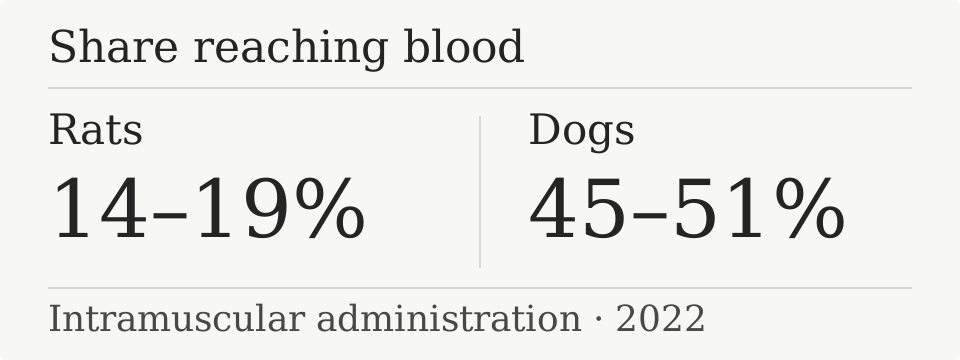
Rat IM Bioavailability

14–19%

IM half-life in rats: 7.87–29.7 minutes dose-dependently.

Dog IM Bioavailability

45–51%

IM half-life in beagle dogs: 20–29 minutes dose-dependently after 6 μg/kg IV.

Primary elimination route: urinary excretion. No oral route pharmacokinetic data was generated in this study [22].

Common Citation Error

Older literature citing a "4-hour plasma half-life" is not supported by the dedicated pharmacokinetic study (Xu et al. 2022). This is a common citation error in secondary sources and review articles.

No validated human pharmacokinetic data has been published. Half-life in humans, volume of distribution, clearance, and oral bioavailability are all unknown.

Oral vs. Injectable BPC-157: Bioavailability in Research Models

Is oral BPC-157 as effective as injectable subcutaneous BPC-157?

For gut-localized endpoints, oral administration is effective — this is consistent with the compound's unusual acid stability (the proline-rich core resists rapid degradation in gastric acid) and the fact that the compound was originally isolated from gastric mucosa.

For systemic endpoints: the picture is more complex. Systemic bioavailability from oral administration appears lower than from injection in rodent models. However, multiple oral-route studies have documented systemic effects — MCL healing, muscle-to-bone reattachment, and behavioral endpoints — at oral doses comparable to IP efficacy doses, suggesting that even lower systemic exposure may be sufficient for some endpoints [5][7][9].

In the MCL healing study, oral (drinking water), intraperitoneal, and topical cream routes all produced comparable healing outcomes at 10 μg/kg and 10 ng/kg [5].

For the route comparison question in research models, the short answer is: oral BPC-157 works for the endpoints it has been tested on. Whether it works for all endpoints at bioequivalent doses to injection is not established — the head-to-head bioavailability comparison has not been conducted.

BPC-157 Acetate vs. Arginine Salt Formulations

What is the difference between BPC-157 acetate and BPC-157 arginine salt?

The acetate salt (BPC-157 acetate) is the form used in virtually all published research. When a study cites "BPC-157," it is almost always the acetate form.

The arginine salt (BPC-157 Arg) has been proposed for oral delivery, with the hypothesis that the arginine counter-ion provides superior stability in the gastrointestinal tract. This claim appears primarily in commercial and patent literature. No peer-reviewed head-to-head bioavailability comparison between acetate and arginine salt has been published in humans or in a rigorous animal model.

Most published oral administration studies used the standard acetate form in drinking water, and documented efficacy at gut-localized and systemic endpoints — suggesting the acetate form is itself acid-stable enough for oral research use without the arginine modification.

For the acetate vs. arginine salt formulation question: the research literature supports acetate; the arginine salt is an extrapolation from theory without comparative published data.

Storage guidelines

How should BPC-157 be stored to maintain stability? Lyophilized powder: stable at room temperature short-term. Reconstituted solution: refrigeration required; use within 30 days per standard peptide handling practice. Acetate salt is generally regarded as more stable than other forms at room temperature based on standard peptide chemistry principles — no dedicated BPC-157 stability trial has been published.

BPC-157 Onset of Action in Research Models

Does BPC-157 work immediately? In acute injury models, repair markers appear rapidly.

In the quadriceps muscle reattachment study (Matek et al., 2025), periosteum reactivation was observed at day 3. Full weight-bearing walking recovery was documented. Well-organized muscle-bone contact was documented at 3 months by histology and MRI [7].

In tendon and Achilles models, functional recovery was measured at checkpoints of 1–4 weeks, with biomechanical and histological improvement documented at each interval [4][5].

In acute behavioral models (Porsolt forced swimming test), antidepressant-like effects were measurable within the acute testing window (typically 5–15 minute sessions), with persistent effects documented at 4 and 6 days [15].

In the spinal cord compression model, tail paralysis resolved by day 15 after a single injection at 10 minutes post-injury. Effects persisted to day 360 [14].

The onset window across models is hours to days. Functional recovery window is days to weeks. Long-term effects in rodent models are sustained through the study duration in most experiments.

Routes of Administration Studied

BPC-157 has been studied across more routes than almost any other peptide in preclinical research. Documented routes include:

  • Intraperitoneal (most common in rodent models)
  • Intramuscular
  • Intravenous
  • Oral gavage
  • Oral via drinking water (ad libitum)
  • Subcutaneous (referenced in some model descriptions)
  • Topical cream (skin wound and ligament studies)
  • Local injection at injury site
  • Local injection in nerve tubing (nerve repair model)
  • Intraosseous local injection (bone defect model)

The multi-route efficacy is documented in several head-to-head comparisons within studies. In the MCL healing study, IP, oral, and topical routes all produced comparable outcomes [5]. In the sciatic nerve study, IP, intragastric, local anastomosis, and local nerve tubing routes all produced similar regeneration metrics [13].

No subcutaneous vs. intramuscular vs. IV bioequivalence study in humans has been conducted.